karwingowej Driving technique is a natural technique for skiing. However, even in the natural model, some of the movements and positions are not entirely consistent with our intuition.
karwingowej Driving technique is a natural technique for skiing. We are skiing in a natural, comfortable position, directed his body in the direction in which we go and we do not do unnatural, unnecessary movements. Simply put: put on the edges of skis are going by themselves and we lead them, mainly by moving your center of gravity. However, even in this beautiful natural model, certain movements or positions are not entirely consistent with our intuition or acquired reflexes.

Domination skiing outside
One of the basic principles of skiing is determined to charge one leg - the outer leg. This is proved on the basis of the laws of physics that the application of all or nearly all of our weight to the outer edge of the ski makes a deeper pocket the skis into the snow and skiing better than keeping your weight distribution on the edges of both skis outside and inside. This is particularly important on steep slopes and hard wherever you ski a perfect grip us to control the ride and protect yourself against a violent ześliźnięciem skiing and as a result often fall.
So we always use the principle of "domination of the outer ski" in the strict and harsh conditions are easier (a gentle slope, soft snow), as a more loose.
Horse on one leg is a bit contrary to our natural impulse prop up our bodies as widely as possible, the impulse that tells us the equal use of both legs. Eradicate this reflex is not difficult but requires some conscious effort. The easiest way to reach practicing an exaggerated version of the "domination of the external legs" or ride on one leg.
For this exercise, the best choice sloped gently and the blue route, avoiding, however, very flat stretches - slow ride on one leg is probably more difficult than driving too fast.
gaining proficiency with the time increasing the steepness of slope, speed and time spent on one leg up to the point where it becomes our new way of driving a knee-jerk. It should be remembered that in normal driving inside leg remains in the snow and full of more or less much a supporting role.
inclination forward
second, not entirely compatible with our instincts, is heading to the ski slope to the front and pushing fronts skis, especially in the initial phase of the turn. This position has significant advantages over intuitive and often observed on the slope of the driving position back so inclined. "Riding on the back." First, we are committed firmly to the front of the ski turn, clearly setting out or even cut out in the snow track, after which then moves the entire ski. Secondly, due to deeper sidecut skis in the front part compared to the rear, using skis fronts are setting tighter arc driving a widening or reducing the pressure on the fronts modify the appropriate turning radius. Another, non-trivial advantage przodach driving is much less risk than a ride on the back "to take the" skis from us forward, resulting in painful bumps and cushioned back of the body.
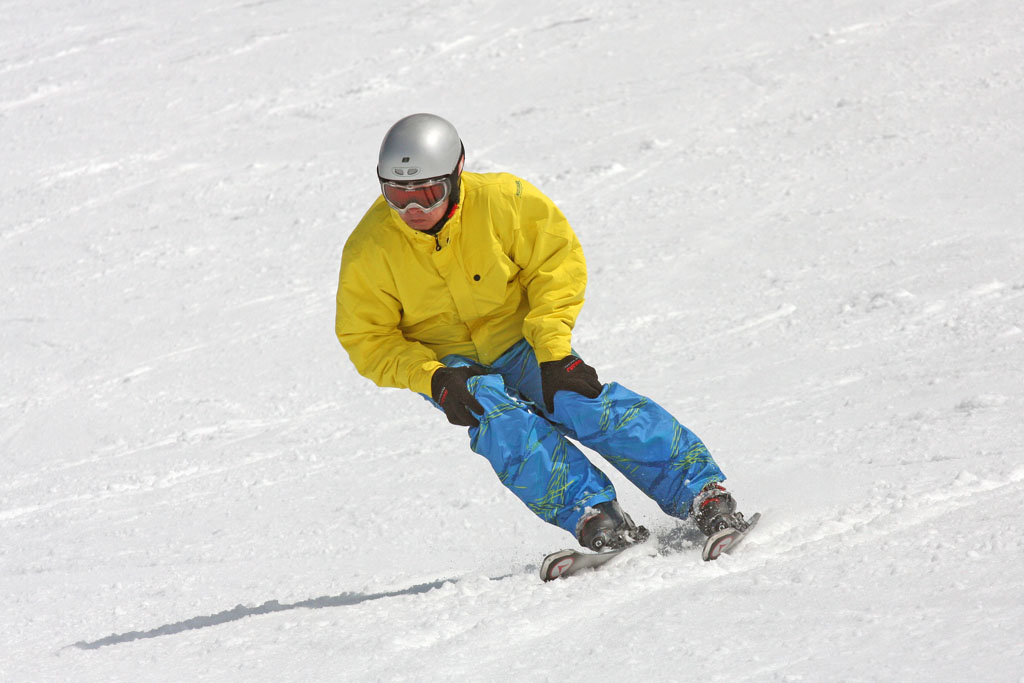
Pressure fronts, we can practice in many ways.
The first way is to consciously skew our profiles to the front in normal driving, especially at the beginning of the turn. The confirmation of this tilt is a feeling of pressure on the languages \u200b\u200bof shoes and undeniable proof touch the front of the ski and snow in all phases of the turn, you see in photographs or films with our run. If it makes us a particularly difficult (and often make), we can exercise pressure forced front of the skis, riding with hands located on the knees, shins dociskającymi mechanically to the languages \u200b\u200bof our shoes. The next exercise, a possible connection to exercise "calm arms" (as in a moment) is driving from united by horizontal poles that every time you go to the initiation phase of the turn, strongly pushed forward.
Quiet arms
Skiing is a dynamic exercise. Alternate move our center of gravity from one side to the other ski, and each time catching the balance in the extreme lateral deflection is something of a walking a tightrope. I like walking a tightrope, a young acrobat waving his arms quite chaotic, so we execute a lot of arm movements, which are (at least so we think) to help us catch the balance. With time, acrobat, who is adept ski champion and with the development of their skills find that the more efficient movement of hands and arms all the more calmer and easier to maintain fluid balance. Therefore, we should seek from the beginning to calm down our arms and reduce hand movements to a minimum. In an extreme variant of driving broad, gentle twists, our arms remain motionless practical and what is more owing to the collapse of the hips (as in a moment) and so our shoulders and arms are in the second and third phase twist in a position parallel to the ground.
It is ideal to which we strive for. In fact, the slope seen many variants of improper conduct in a twist of shoulders. The most common mistakes, leave your hands back and especially the fall and left hand inside the back (but with excessive rotation of the body down the slope, it is possible that is also a variant on the opposite hand on the back of Staying outside). Moreover, there is a wide range of various "wymachiwań" poles, which we observe on the slopes, some of them seem to be close to the art of fencing.
to unlearn all the options overly active arms, they must be completely calm down, as it were "frozen" in a proper and comfortable position.
This is achieved by driving the poles been handled or united by a horizontal or slightly more difficult version kept separately in an upright position but kept the same level.
collapse in the hips last longer
element for which we want to draw attention, and which often causes difficulty for us is the lateral deflection in the figures of our time skiing or collapse in the hips. The natural reaction to the increasing centrifugal force, arising during the rapid-turn is simply the inclination of the body in the direction of center of the turn. So riders are doing or we Tor riding a bike while crossing arcs, so they do speed skaters at the rounded parts of the track.
For skiing, our point of support does not fall exactly in the natural projection of our center of gravity as a bicycle (tires narrow measure) and skating (narrow skate). Skiing the fulcrum is situated more or less on the side, depending on the width of the ski under the thumb, edge of the ski. Therefore, to the maximum weight on the edge, we move our center of gravity even more to the center of the turn, pushing in this direction our hip. At that time, our top half bend a little in the other side and thus get the edge perfectly weighted down while its maximum zakrawędziowanie - punching into the snow. Both results, taken together, give us what we most need in a dynamic twist - the perfect grip of the ski.

Science sagging of the hips is also based primarily on self-aware "wpychaniu" internal hips turn toward the center during normal driving and monitoring progress by analyzing the images or videos from our observations of driving or friends with whom we go.
If due to the habits, body structure or natural limited flexibility in the hips, the movement of the hips push comes to us with great difficulty, we can help them mechanically pushing the outer arm, or doing an exercise known as "krakowiaczkiem.
Peszek Agnieszka
Peszek Agnieszka


0 comments:
Post a Comment